Cold-water corals reefs are home to a diverse set of animals. Using a Lophelia pertusa reef as an example, we’ll take you on a voyage through the different zones of the reef and meet some of the amazing animals that live there.
Shoals of fish swim above the bright white thickets of living coral but closer inspection shows the live coral to be only one part of the reef. The living coral caps a framework of dead coral skeletons, which traps sand and mud creating a complex habitat where the majority of the reef’s inhabitants live.
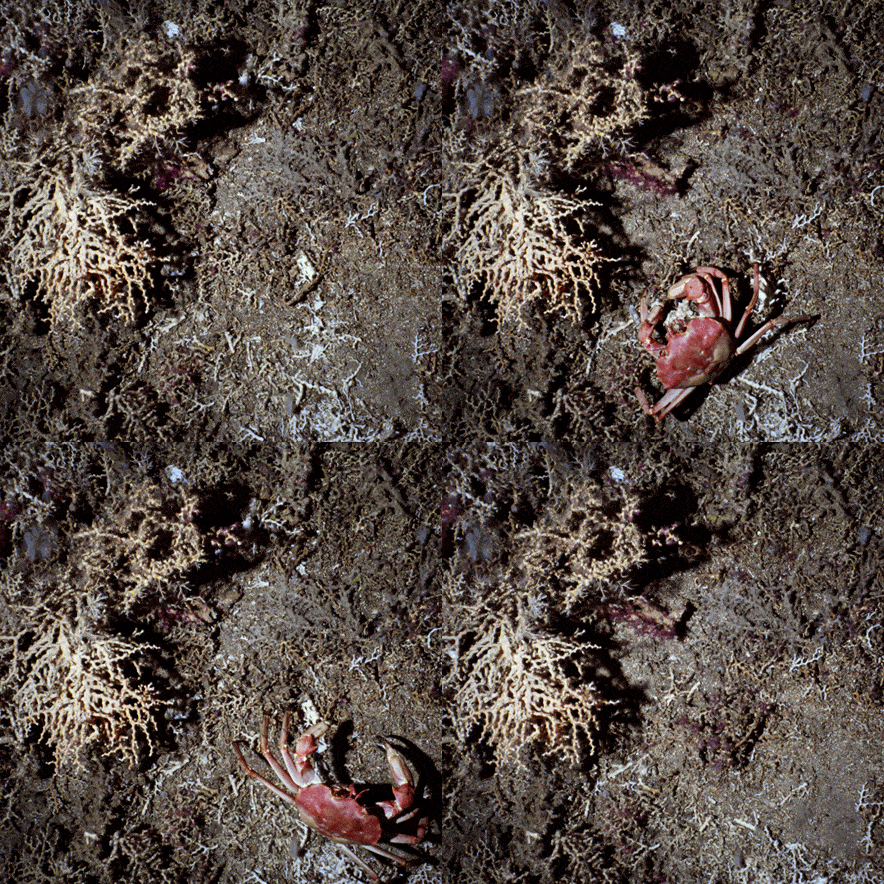
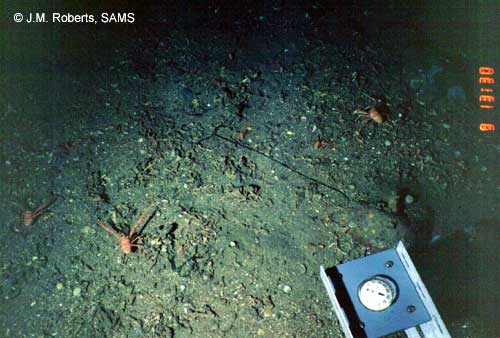
Surrounding the reefs, are banks of coral rubble, interspersed with small colonies of living coral. This was once part of the living reef, but through a process called ‘bioerosion’ the coral framework is gradually broken down by a variety of different eroding animals.
Life above the reef
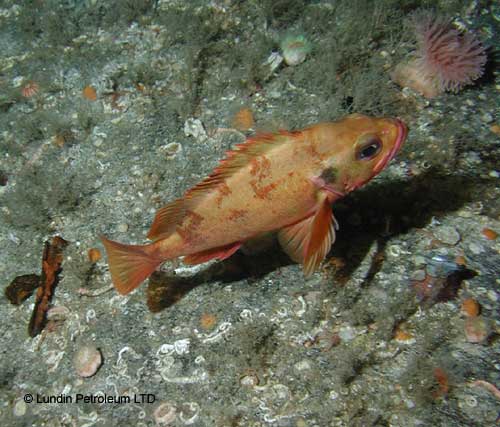
Sebastes sp. (Redfish) – redfish are highly prized and have been fished for many years
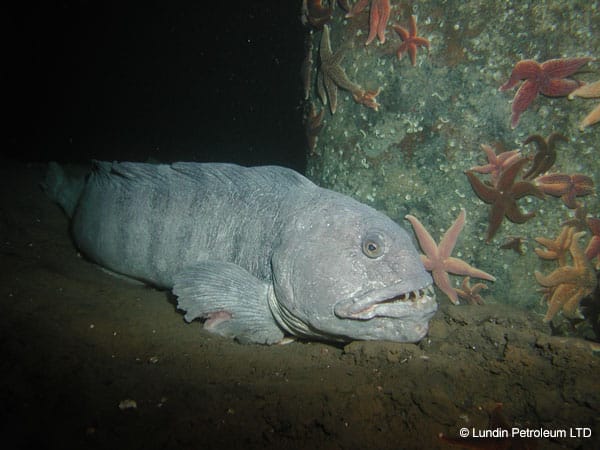
Anarhichas lupus – the wolf fish – has very powerful jaws that it uses to eat crabs, echinoderms and molluscs.
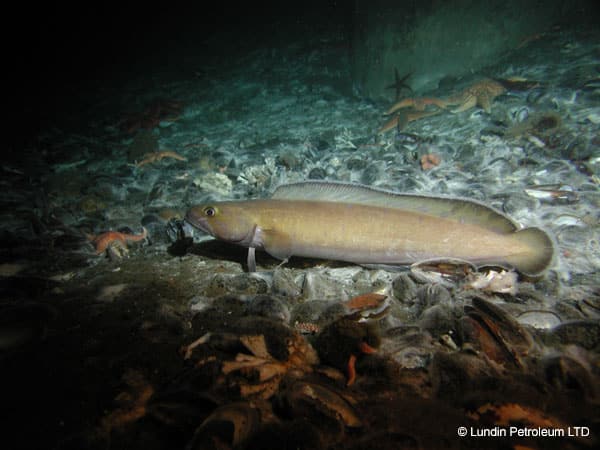
Brosme brosme is a highly commercial fish species found on cold-water coral reefs.
Life above the reef is dominated by highly mobile animals such as fish. They form shoals, circling above. These animals may never stray far from the reef, depending on it for food and shelter. The reefs seem to provide important habitats for fish like redfish (Sebastes spp.), perhaps giving them shelter to spawn their young.
Some common species of fish observed on and around cold-water coral reefs include: wolf fish (Anarhichas lupus), tusk (Brosme brosme),ling (Molva molva), orange roughy (Hoplostethus atlanticus), monkfish (Lophius piscatorius), cod (Gadus macrocephalus) and many others.
Life on the reef
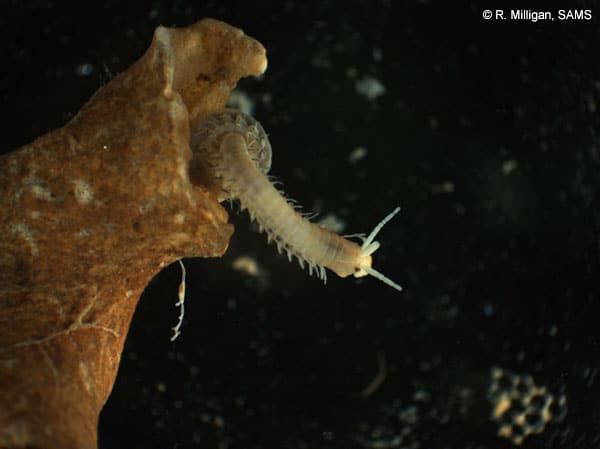
Eunice norvegica – a bristleworm that lives in a parchment tube on the surface of Lophelia pertusa and other cold-water corals.
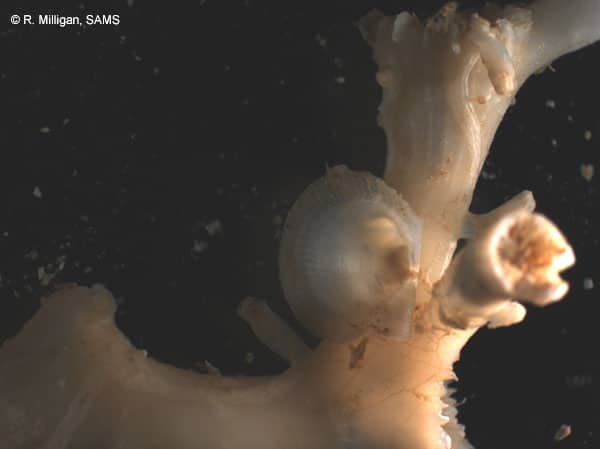
Bivalve – many bivalves can live on the surface of dead coral, attached by the fine strings they secrete.
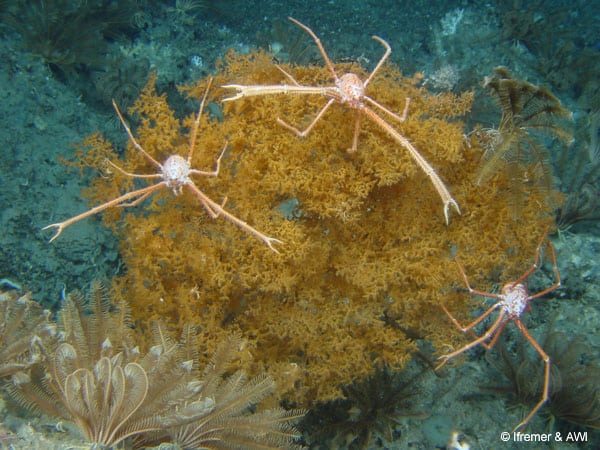
Squat lobsters – some mobile animals are closely associated with live corals. This squat lobster is often seen sitting on these bright orange antipatharian corals
Live coral dominates this area. The coral polyps actively feed in the water column, catching passing plankton and other food particles. The corals are covered in a layer of mucus and are able to prevent most other animals overgrowing them. But we do know about a few specialists who are able to live in amongst the live corals.
The worm Eunice norvegica lives on the coral skeleton where it builds a delicate parchment tube. Over time the coral encases this tube in its limestone skeleton effectively incorporating it into the reef framework. By observing the worms living in Lophelia corals in aquarium tanks we have learnt more about their relationship. The worms explore the coral branches perhaps helping to keep them clear of debris and defending them from attack. Interestingly the worms are strong enough to move small coral colonies and join them together. It seems that over time this behaviour will help build patches of coral and quicken reef growth. Other animals living with live coral are not so helpful. The parasitic foraminiferan Hyrrokin sarcophaga etches into the skeleton feeding on live polyps.
A slate pencil urchin (Cidaris cidaris) crawls over a reef growing on a carbonate mound.
A spider crab wearing a covering of gorgonian coral
Coral polyps divide and as the daughter polyps grow and eventually divide themselves the coral colony expands. Lophelia polyps are thought to live for between 10 and 15 years after which they die back leaving bare skeletons. This dead coral framework can trap sands and mud (helping to build the reef structure) and is an important habitat for many other species.
Over time the dead coral is broken apart, especially by other animals that bore into the structure, and the coral rubble falls to the seafloor. Here the rubble can accumulate to form aprons around the base of the reef. Coral rubble often contains the most animal varieties on the reef, with hundreds, if not thousands of species of many shapes and sizes. The larger, more conspicuous include other species of cold-water coral, actinians and sponges. Smaller organisms such as bivalves, hydrozoans, barnacles, gastropods, crustaceans and countless worms are frequently found crawling amongst the rubble and feeding from the fine sediment.
Fringing habitats
An echiuran worm (probably Bonellia viridis) emerges from its burrow to feed
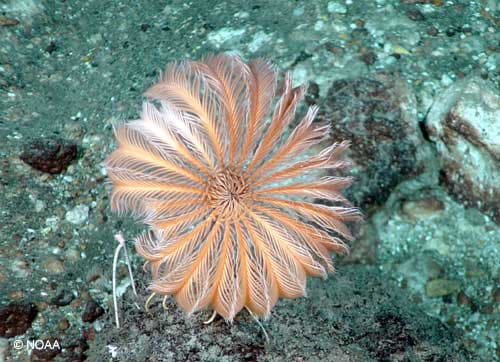
Crinoids are calcified filter feeding echinoderms. They are very widespread in areas of fast current flow
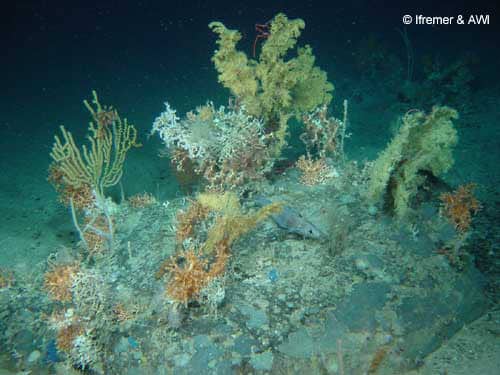
A small community of corals and sponges colonising a boulder
Next to the richness and diversity of the life on the reef structure, the fringing habitats can initially appear barren. There are still animals here but they are hidden from view burrowed within the seabed. Here many species of marine worms live often feeding from within the sediment or by occasionally emerging to scour fresh organic material that has settled onto the seabed.
Sometimes small oasis-like communities are found surrounded by flat seafloor, perhaps colonising a small boulder that was dropped from an iceberg thousands of years ago.
Henry L-A, Davies AJ, Roberts JM (2009) Beta diversity of cold-water coral reef communities off western Scotland. Coral Reefs 29(2):427-436
Henry L-A, Roberts JM (2007) Biodiversity and ecological composition of macrobenthos on cold-water coral mounds and adjacent off-mound habitat in the bathyal Porcupine Seabight, NE Atlantic. Deep Sea Research Part I: Oceanographic Research Papers 54(4):654–672
Danovaro R, Company JB, Corinaldesi C, D’Onghia G, Galil B, Gambi C, et al (2010) Deep-sea biodiversity in the Mediterranean Sea: the known, the unknown, and the unknowable. PLoS One 5(8):e11832
Le Guilloux E, Hall-Spencer JM, Soffker MK, Olu K (2010) Association between the squat lobster Gastroptychus formosus and cold-water corals in the North Atlantic. Journal of the Marine Biological Association of the United Kingdom 90(7):1363-9
Ramirez-Llodra E, Brandt A, Danovaro R, De Mol B, Escobar E, German CR, et al (2010) Deep, diverse and definitely different: unique attributes of the world’s largest ecosystem. Biogeosciences 7(9):2851-99
Roberts JM, Davies AJ, Henry LA, Dodds LA, Duineveld GCA, Lavaleye MSS, et al (2009) Mingulay reef complex: an interdisciplinary study of cold-water coral habitat, hydrography and biodiversity. Marine Ecology-Progress Series 397:139-51
Ross SW, Quattrini AM (2007) The fish fauna associated with deep coral banks off the southeastern United States. Deep-Sea Research Part I-Oceanographic Research Papers 54(6):975-1007
Stone RP (2006) Coral habitat in the Aleutian Islands of Alaska: depth distribution, fine-scale species associations, and fisheries interactions. Coral Reefs 25(2):229-38